Foundations of Faith: The Rise of Islam
Religions are among the most influential and universal symbols that could impact how one values life. Encompassing approximately 2 billion Muslims, or 25.6% of the world’s population, “Islam” is the second largest religion around the globe. Islam stands for Muhammad’s submission and peace to God in Arabian. During Muhammad’s life, from 570 to 632 AD, his influence had not yet spread beyond the Arabian Peninsula. Following the Umayyad Dynasty (661-750 AD) and the Abbasid Dynasty (750-1258 AD), an Islamic empire spanning Europe, Asia, and Africa was gradually established (National Religion Information Center, 2014). Islam is the most widely practised religion in Southeast Asia, with approximately 242 million adherents in the region. The majority of Muslims are located in Brunei, Indonesia and Malaysia, as well as parts of southern Thailand and parts of Mindanao in the Philippines respectively.
Muslims believe in one unique and indivisible God— Allah, the creator of all things. The prophets sent by God, including Adam, Noah, Abraham, Moses, Jesus, and Muhammad, who is considered the final prophet, to guide humanity. Quran/ Koran is the central text of Islam. It is believed as a divine verbal revelation from God to Muhammad through the angel Gabriel, gradually over a period of approximately 23 years. Starting from December 22, 609 CE, when Muhammad was 40, and concluding in 632 CE, the year of his death (Lumen Learning, 2020). Recording all categories of humankind and justice, the Quran emphasizes the absolute unity and uniqueness of God. In addition to ethicality, it depicts one’s afterlife in terms of the rewards of Paradise for the righteous; and the punishments for the wicked. Devout Muslims would worship their daily prayers, known as Salah, 5 times a day. This not only demonstrates the commandment in Islam, but a way to connect with God, express gratitude, seek forgiveness, and find solace.
Unveiling the Hijab: Meanings & Symbolisms
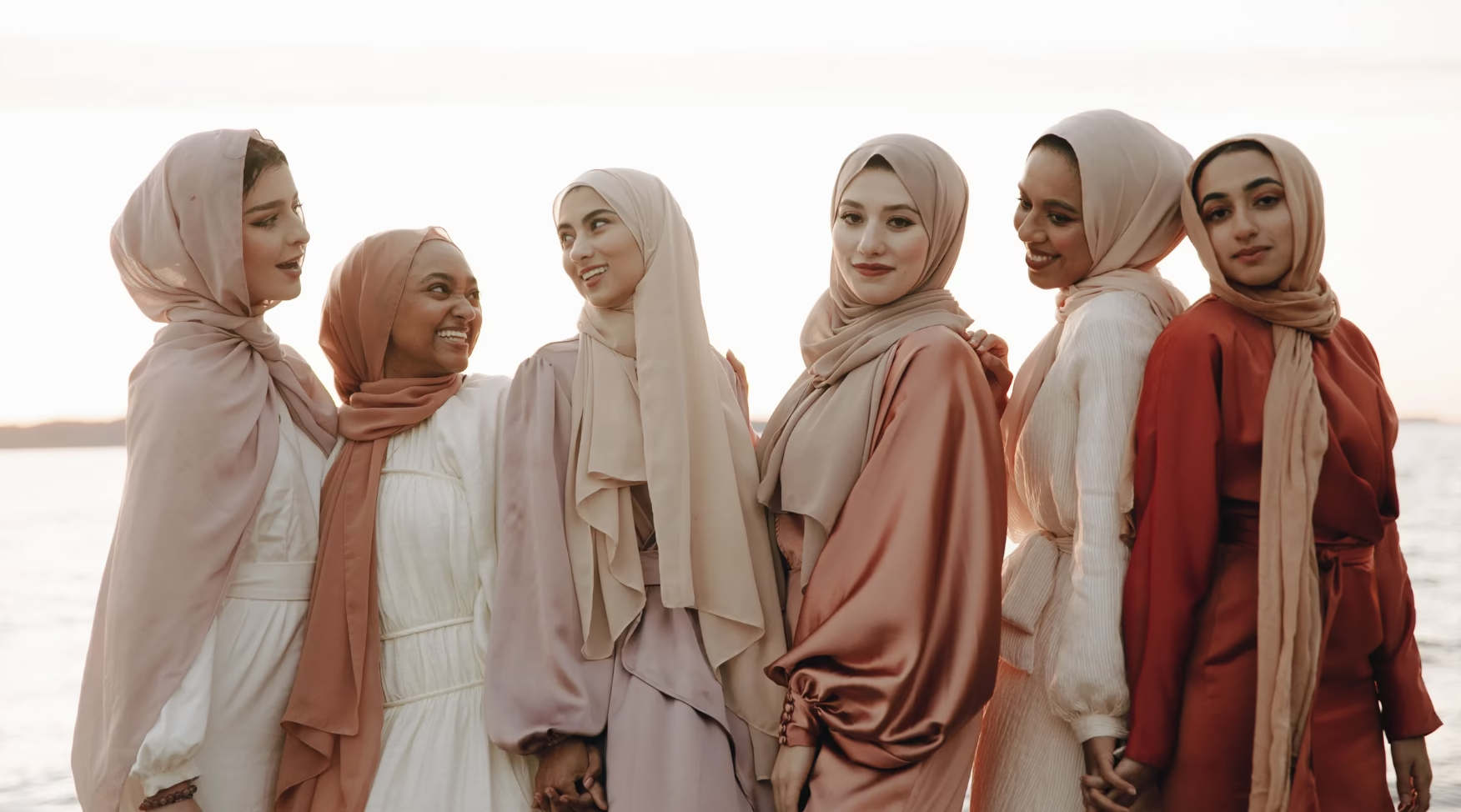
Hijabs are one of the most commonly seen features on a Muslim woman’s body. It refers to a scarf that is wrapped around the head, covering the hair, neck, and ears while leaving the face visible. The global prevalence of Hijabs has been active since the 70s, with many Muslims viewing it as a symbol of faith and modesty. However, younger, middle class generations converted how Muslims define Hijabs, transforming its social meaning by a large extent.
Shifting Identities: Islamic Revivalism
Islamic Revivalism emerged in the 1970s in Indonesia and Malaysia, highlighting a belief that Islamic values and religious activities should play a role in politics, the economy, dress, food, clothing, and people’s general lifestyles. It marked a step forward from the past, advocating for the revival of Islamic spirit and values, as to “return to Islam by revolting against political corruption”. This large-scale movement was led by intellectuals and students that are middle class or above, who benefited from new economic policies that are mostly Westernized educational systems. It is connected to SDG 4, Quality Education, since it aims to ensure inclusive and equitable quality education and promote lifelong learning opportunities for all. Due to the fact that the majority of advocates are intellectuals who grew up under a more modernized and innovative educational system, qualified education is influential to one’s perspective among equity and freedom. This emphasized the fundamental teachings and principles of Islam, which has impacted the general lifestyles of Indonesians and Malaysians. Moreover, it focused on democratization, human rights, and freedoms, demanding action to empower people and boost their economic capabilities. As the movement spread, Muslim women initiated a feminist movement that sought to protect the values, their social status, and identities of Muslims. By the 1990s, instead of being hesitant to wear Hijabs, many Muslim women were proud of their identity and their appearance while wearing Hijabs.
A second wave of Islamic Revivalism started in the 2000s— an era of y2k outfits and trends. This wave is known as Pop Islam or Modern Islam, indicating a mix of Islam, democracy, and the culture that developed among middle class urban-dwelling Muslims. Media exposure has predominantly impacted the spread of democratization of Pop Islam. The increase of conscious and educated Muslim women who received Western or higher quality education has elevated the overall social meaning of wearing Hijabs, which could once more be linked to SDG 4, quality education. The more educated women exist, the more renewed and modernized ideas are brought to the society. Muslim women began to redefine Hijabs as “belong to Islam” and they would be proud of being trendy. Hijabs are gradually changing to symbols of self-identity and fashionable items. Yet, the interpretation of Hijabs’ evolving tradition varies among Muslims. Some would view it as a religious obligation and a form of devotion rooted by the Quran; while some would view it as a religious oppression.
Silent Power: The Inner Strength Behind the Veil
According to an interview of a Hijabi, she stated that she often faces harsh criticisms or sarcasm due to the contradiction of her viewpoints with her physical appearances. She would consider both her right and duty to prevent another woman from experiencing the same contradiction between what she wants and what is imposed on her. Hijabs are something that she has embraced in her entire life, and she has grown loving the point that it feels like a part of her body, and something that she cannot do without. Muslim girls must start wearing Hijabs as soon as they turn 9 years old. At this age, signs of puberty begin to appear, breasts begin to emerge and waist takes shape, marking the transition from childhood to maturity. This takes us back to the stereotypical view of women in monotheistic religions, where physical maturity is understood to mean that a girl’s body has become an object of desire. It is capable of arousing a man’s instincts, and as symbols of sin, sources of seduction, and evil, girls must cover themselves to avoid becoming a source of temptation. Therefore, this controversy has been prevailing in Muslim societies for a long period of time. However, in recent years, the stereotypical idea of viewing Hijabs as a coercion has been shifted by a large degree. She has never thought of removing her Hijab and it has never been an obstacle in her life, despite Hijabs still remain as an invisible form of suppression exerted by the highest forces of family, society, religion, and politics.
Faith & Freedom: A Hijab of One’s Own
Nowadays, the true definition of Hijabs is not only constrained by religious repression and obligation, but also a genuine belief of “belong to Islam”. The growth of educated Muslim women who received Western or higher quality education has replaced the social identity of wearing Hijabs of embracing their religion and dressing in a chic manner. The interpretation of Hijabs could vary from one another. Nonetheless, an unchanging reality in Islam is the authentic belief of “no one is superior to another except in piety and good deeds”. Every human being deserves to be treated equally and with respect.
References
Alkiek, T. (2021, March 25). Is Hijab Religious or Cultural? How Islamic Rulings Are Formed. Yaqeen Institute for Islamic Research. https://yaqeeninstitute.org/read/paper/is-hijab-religious-or-cultural-how-islamic-rulings-are-formed
Fahs, B. (2025, February 5). I Wear A Hijab — Here’s How To Ensure True Choice For Every Muslim Woman. Worldcrunch. https://worldcrunch.com/culture-society/hijab-choice-muslim-women/
Goraya, A. (2020, February 26). Why Muslims Pray 5 Times a Day. Review of Religions. https://www.reviewofreligions.org/20026/why-muslims-pray-5-times-a-day/
International Islamic University Malaysia. (2025). The Last Sermon Of Prophet Muhammad(SAW). Www.iium.edu.my. https://www.iium.edu.my/deed/articles/thelastsermon.html
Lipka, M., & Hackett, C. (2017, April 6). Why Muslims are the world’s fastest-growing religious group. Pew Research Center. https://www.pewresearch.org/short-reads/2017/04/06/why-muslims-are-the-worlds-fastest-growing-religious-group/
Lumen Learning. (2020). The Quran | World Civilization. Lumenlearning.com. https://courses.lumenlearning.com/suny-hccc-worldcivilization/chapter/the-quran/
National Religion Information Center. (2014). Islams. National Religion Information Center; National Religion Information Center. https://religion.moi.gov.tw/Knowledge/Content?ci=2&cid=85
Park, H. (2022). The Fashioning of Southeast Asian Muslim Women’s Clothing from the Perspective of Social Phenomena and Global Market Changes. Journal of Textile Science & Fashion Technology, 9(4), 1–5. https://doi.org/10.33552/JTSFT.2021.09.000718
UN SDG. (2025). Goal 4: Quality education. The Global Goals. https://globalgoals.org/goals/4-quality-education/
United Religions Initiative. (2020). Islam: Basic Beliefs. Www.uri.org; United Religions Initiative. https://www.uri.org/kids/world-religions/muslim-beliefs
Wikipedia Contributors. (2019a, January 12). Hijab. Wikipedia; Wikimedia Foundation. https://en.wikipedia.org/wiki/Hijab
Wikipedia Contributors. (2019b, March 4). Quran. Wikipedia; Wikimedia Foundation. https://en.wikipedia.org/wiki/Quran
Wikipedia Contributors. (2019c, May 13). Islam in Southeast Asia. Wikipedia; Wikimedia Foundation. https://en.wikipedia.org/wiki/Islam_in_Southeast_Asia
Wikipedia Contributors. (2019d, September 21). Muslims. Wikipedia; Wikimedia Foundation. https://en.wikipedia.org/wiki/Muslims